
Profound vs Writesonic vs Guzu: Which AI Visibility Tacking Tool Is Actually Worth Paying For?
Most people shopping for best AI visibility tools want one thing:
When someone asks ChatGPT / Gemini / Perplexity what to buy… are we getting mentioned, and are competitors stealing the recommendation?
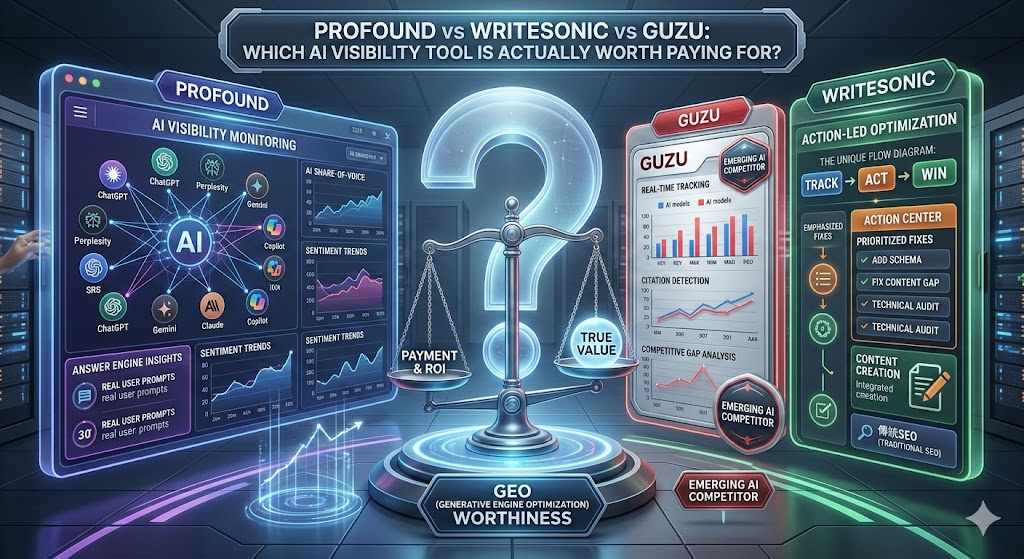
Profound, Writesonic, and Guzu all play in that space. But they feel like three totally different product philosophies:
- Profound = enterprise platform energy
- Writesonic = full suite (content + SEO + GEO)
- Guzu = focused tracker you can actually run every week without hating your life
Here’s what you’re really buying with each one.
1) Profound (TryProfound)
What it feels like
Profound feels like something built for enterprise visibility programs. Broad “answer engine” coverage, lots of surface area, and the vibe is: “this is a platform you roll out.”
Profound also publicly lists a wide set of engines/models it tracks (ChatGPT, Perplexity, Gemini, Copilot, Claude, Grok, DeepSeek, AI Overviews, AI Mode, etc.).
Pros
- Very broad coverage across AI engines/models (useful if leadership wants “everything”).
- Enterprise-ready framing (it’s trying to be a program tool, not a lightweight tracker).
Cons (aggressive, because it matters)
- Starter is basically a teaser. Their own material says Starter is $99/month and ChatGPT-only. If you want multi-engine reality, you’re pushed up the ladder.
- Prompt limits at entry tier (the pricing page shows ChatGPT-only with 50 prompts tracked on that plan). That’s not “enterprise insight,” that’s “you’ll hit the ceiling fast.”
- Can be too heavy for teams who just want weekly competitor checks. Independent reviews call out higher pricing tiers and a steeper learning curve / complexity for smaller teams.
- Confusing trial messaging depending on where you look. Profound mentions trials in its own content, but third-party pages have reported no trial / sales-led access in the past—this inconsistency creates doubt during evaluation.
Who Profound is best for: big brands that can afford the platform tax and will actually use it across stakeholders.
2) Writesonic (GEO / AI Search Visibility)
What it feels like
Writesonic feels like a full-stack suite that happens to include AI visibility (GEO). If you want one tool for content + SEO workflows + AI visibility monitoring, it’s trying to be that.
Pricing is clear and public: Lite $49, Standard $99, Professional $249, Advanced $499.
Pros
- Clear pricing ladder and trial CTA right on pricing.
- If you’re the kind of team that wants one suite for content + SEO + AI visibility, the “all-in-one” approach is convenient.
- Strong emphasis on “optimization,” not just tracking (their positioning is “AI search optimisation platform”).
Cons (aggressive)
- You pay suite pricing even if you only want tracking. If your content workflow already exists (agency/in-house stack), a suite can become expensive bloat. Their own tiering basically signals: GEO becomes serious at Professional ($249/mo) and above.
- The product is trying to do too many jobs. “All-in-one” sounds great until you realize you’re paying for a content engine + SEO tooling when you mainly needed “brand vs competitor presence inside AI answers.”
- Higher tiers get pricey fast. Advanced is $499/month — if your goal is visibility tracking, that jump can feel brutal.
- Biased comparisons exist. Writesonic publishes comparison content that frames itself as the “only full GEO platform.” That’s marketing, not neutral evaluation—so buyers should treat it like sales collateral.
Who Writesonic is best for: teams who genuinely want the suite and will use content + SEO automation heavily, not just tracking.
3) Guzu
What it feels like
Guzu feels like a purpose-built tracker: track visibility frequently, compare competitors, watch trends, and act. Less “platform theater,” more “weekly operator tool.”
It tracks citations across ChatGPT, Perplexity, Gemini, Claude, Grok, and AI Overview.
It also has a very clear cadence: daily and weekly tracking options, and explicitly supports tracking up to 105 queries and up to 5 competitors.
Pros
- Built for cadence. Daily and weekly tracking is baked into the product design (not an afterthought).
- Competitor-first by default. It’s clearly oriented around share-of-voice, market position, and “where we rank vs competitors.”
- Transparent pricing + flexible plan shapes. You can do single-AI plans or multi-AI bundles (e.g., Advanced Pro bundles ChatGPT + Perplexity + Gemini at $359/mo).
- Free trial exists and doesn’t require a huge commitment (10 days, $0).
Cons (lighter, but real)
- Free trial is Gemini-only. Good for testing workflow, but not a full “all engines” trial.
- Claude frequency caveat on the top plan. The Enterprise Pro plan notes “daily analysis (Claude weekly)” — that’s a detail buyers will notice.
Who Guzu is best for: agencies + in-house SEO/growth teams who want tracking to become a weekly habit and don’t want suite bloat or enterprise overhead.
The honest conclusion (and why Guzu wins quietly)
If you’re enterprise and want a big platform rollout, Profound can make sense — but the entry tier is narrow and you’ll climb into heavier pricing/complexity quickly.
If you want a full suite for content + SEO + GEO, Writesonic is clean — but you pay for the suite whether you need it or not, and GEO becomes meaningful at higher tiers.
For most teams, the job is simpler: track AI visibility, compare competitors, see trends weekly, act, repeat. That’s exactly the gap Guzu fills best — without trying to be your content platform or your enterprise program dashboard.

Write a Comment