
What Is a GEO Audit and Why It Matters in 2026
For twenty years, the question every brand asked about search was simple: where do we rank? Position one, position three, page two. Rankings were the scoreboard, and the entire SEO industry was built around climbing it.
That scoreboard is no longer the only one that counts — and for a growing share of queries, it isn’t even the one people see.
When someone asks ChatGPT for “the best project management tool for a small agency,” or types a question into Google and reads the AI-generated summary at the top before scrolling, they’re not looking at ten blue links. They’re being handed a synthesized answer that names a handful of brands and cites a handful of sources. If you’re not in that answer, you effectively don’t exist for that query — no matter how well you rank underneath it.
This is the gap a GEO audit is built to measure. And if you haven’t run one yet, you’re almost certainly flying blind on a channel that’s already shaping how customers find you.
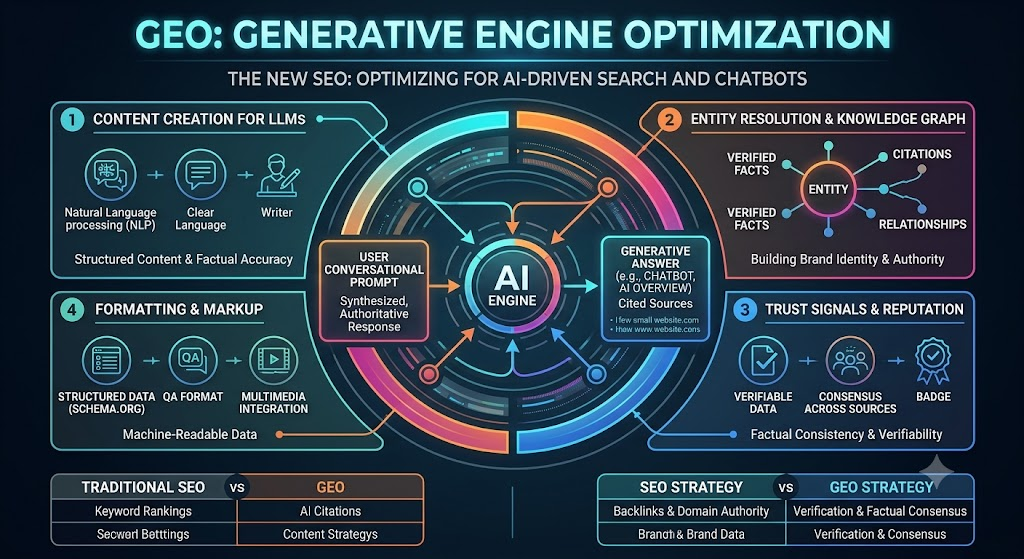
First, what is GEO?
GEO stands for Generative Engine Optimization — the practice of getting your brand mentioned, cited, and recommended by AI answer engines like ChatGPT, Google’s AI Overviews, Perplexity, Gemini, Claude, and Microsoft Copilot.
It’s the natural successor to SEO, but the target has changed. Traditional SEO optimizes for a ranked list of links. GEO optimizes for a generated answer. The difference matters because of how these systems behave: an AI engine reads across many sources, decides which ones to trust, and weaves a single response that may mention some brands by name while linking to only a few. Winning is no longer about being the highest link. It’s about being the source the model reaches for when it composes its reply.
That shift isn’t theoretical. Google’s AI Overviews now appear on roughly half of all U.S. search queries — up sharply from a small fraction just over a year earlier — and have rolled out across more than 200 countries and 40 languages, reaching well over a billion users a month. ChatGPT alone was processing on the order of 2.5 billion prompts a day by mid-2025, with hundreds of millions of weekly users. Meanwhile, Pew Research found that people are far less likely to click through to a website when an AI summary is present — and a majority of Google searches now end without any click at all. The “answer,” increasingly, is the destination.
So what is a GEO audit?
A GEO audit is a structured assessment of how visible your brand is inside AI-generated answers — and, just as importantly, why it is or isn’t.
A traditional SEO audit asks: are your pages crawlable, fast, well-structured, and ranking for the right keywords? A GEO audit asks a different set of questions:
- When real customers ask AI engines about your category, does your brand get mentioned?
- When the engine cites sources for its answer, are you one of them — or is a competitor?
- Across the prompts that matter to your business, what’s your share of voice versus your rivals?
- Which websites and content formats does the AI trust enough to cite — and are you on them?
- What’s structurally stopping the models from quoting you: thin content, no schema, blocked AI crawlers, weak entity signals, stale information?
The output of a good GEO audit isn’t a vanity score. It’s a map: here are the questions your customers ask AI, here’s who’s winning each one, here’s exactly where you’re absent, and here’s what to fix first.
Why a GEO audit matters now (not next year)
It’s tempting to file AI search under “interesting, but not urgent.” The data says otherwise — and so does the competitive math.
The visibility you can’t see is the visibility that’s hurting you. Here’s the uncomfortable part: your existing tools won’t catch this. Google Search Console shows you impressions and clicks, but it won’t tell you which queries triggered an AI Overview, whether you were cited inside it, or how you look on ChatGPT or Perplexity. Rank trackers like Ahrefs and Semrush tell you your position — but ranking #1 is no longer a guarantee of inclusion in the AI answer. Industry analyses in early 2026 found that only a small minority of AI Overview citations even come from pages ranking in the organic top 10. Your dashboards can be green while your AI visibility quietly bleeds out.
Citation is the new click — and it’s measurably valuable. Multiple studies through 2025 and 2026 found that brands cited inside AI answers earn dramatically more engagement than uncited brands on the same queries — by some measures more than double the clicks per impression. Being named is the new ranking. The brands that figure out why they’re being cited (or skipped) get to engineer more of it.
Most of your competitors haven’t started. This is the part founders miss. As of 2026, only around a quarter of marketers were actively measuring GEO at all — while more than half said they planned to start within the next few months. That’s a closing window. The brands that audit and optimize now are establishing citation positions in AI answers that are sticky and hard to dislodge later, the same way early SEO winners locked in rankings that took competitors years to challenge.
The shift is structural, not seasonal. AI Overviews didn’t just appear and plateau — query coverage grew roughly 58% year over year heading into 2026, with near-total saturation in informational, research-heavy verticals like healthcare, education, and B2B technology. This isn’t a feature you can wait out. It’s the new shape of the front page.
What a GEO audit actually examines
Not all “AI visibility checks” are equal. A thorough GEO audit goes well beyond a single search to look at the full picture. Here’s what a serious one covers.
1. Cross-platform citation and mention tracking
The foundation. The audit runs a representative set of real customer prompts across the major engines — ChatGPT, Perplexity, Gemini, Google AI Overviews, and increasingly Claude and Copilot — and records two distinct things: whether your brand is mentioned in the text of the answer, and whether your site is cited as a linked source. These aren’t the same. You can be mentioned without being cited (the model knows you but doesn’t send traffic) or cited without prominence. A good audit separates them.
2. Prompt and query coverage
A single prompt tells you almost nothing. The audit should map the realistic questions buyers ask at each stage — category questions (“best X for Y”), comparison questions (“X vs. Z”), problem questions (“how do I solve…”), and brand questions (“is X any good”). Coverage across dozens of prompts, not one lucky hit, is what reveals the real pattern.
3. Competitor share of voice
Your visibility is meaningless without context. If you’re cited in 2 of 40 prompts but your top rival is cited in 25, that’s the headline. A GEO audit names the competitors winning each prompt and quantifies the gap, so you know exactly who’s eating your AI visibility and where.
4. Source and citation-gap analysis
This is where the audit becomes actionable. AI engines cite the same trusted domains repeatedly — listicles, review sites, forums like Reddit, editorial roundups, and authoritative reference pages. The audit identifies which third-party sources are feeding citations in your category, then flags the ones citing your competitors but not you. That list is, quite literally, your off-page roadmap: the pages you need to get onto.
5. Content extractability and structure
Models favor content they can lift cleanly: clear definitions, direct answer paragraphs near the top, comparison tables, structured headings, and unambiguous statements of fact. A GEO audit reviews whether your key pages are written in a way an engine can quote — or whether your best information is buried under 600 words of preamble the model will never reach.
6. Technical and schema signals
The plumbing still matters. The audit checks whether AI crawlers are accidentally blocked in your robots rules, whether you’ve published structured data (Organization, Product, FAQ, and similar schema) that helps machines understand your entity, and whether your most important facts are exposed in raw HTML rather than locked behind JavaScript that crawlers may not render.
7. Entity and authority signals
AI engines build a model of who you are — your brand as an entity, what you’re known for, and how credible you appear. The audit looks at the consistency and strength of those signals: are you described the same way across the web, do you have clear expertise and authorship, are you associated with your category in the places models learn from?
8. Freshness
Models increasingly favor current information, and citations decay. A GEO audit flags stale pages and surfaces where outdated content is costing you visibility on time-sensitive queries.
How a GEO audit differs from a traditional SEO audit
The two overlap, but they answer fundamentally different questions.
A traditional SEO audit is about eligibility to rank — crawlability, site speed, internal linking, keyword targeting, backlinks, Core Web Vitals. Its scoreboard is position in a list.
A GEO audit is about eligibility to be cited — mention rates, citation share, source gaps, extractability, and entity strength across multiple AI engines. Its scoreboard is presence in an answer.
You need both. Strong technical SEO still helps you get crawled and indexed, which feeds the AI systems in the first place. But a clean SEO audit can sit right next to total AI invisibility — and most teams have no idea, because they’ve never measured the second scoreboard.
How to run one
You can approach a GEO audit manually or with a tool, and the right answer depends on scale.
The manual route means opening each AI engine, asking your priority prompts one at a time, and logging by hand whether you’re mentioned, whether you’re cited, who’s cited instead, and which sources keep appearing. It’s tedious and hard to keep consistent — AI answers vary by session, location, and phrasing — but it’s a legitimate way to get a first read on a handful of prompts.
The tooled route automates the volume: running dozens of prompts across every platform, deduplicating the noise, tracking share of voice over time, and assembling the source-gap list for you. For most teams, the speed and consistency are worth it, because the value of a GEO audit compounds when you can re-run it monthly and watch the trend.
If you want to see what this looks like in practice, the fastest starting point is to run a free geo audit on your own domain — it checks whether AI engines mention and cite you for your category’s key prompts, and shows which competitors get surfaced in your place. It’s the kind of snapshot that turns “we should probably look into AI search” into a concrete, prioritized to-do list in a couple of minutes.
What to do with the findings
A GEO audit is only as good as the action it triggers. The strongest audits hand you a prioritized plan that usually falls into three buckets:
Content moves — create or rework pages so they’re built to be cited: definitive comparison guides, clear answer-first structure, original data, and FAQ-style coverage of the exact questions buyers ask AI.
Off-page moves — get mentioned and cited on the third-party sources the models already trust in your category: relevant listicles, review platforms, editorial roundups, and community discussions. If AI keeps citing a roundup that lists your competitors and not you, getting onto that roundup is a direct visibility win.
Technical moves — unblock AI crawlers, add the schema that clarifies your entity, surface key facts in crawlable HTML, and refresh stale content.
Then you re-run the audit and measure whether your mention and citation rates climbed. That feedback loop — audit, act, re-audit — is what separates brands that talk about AI search from brands that actually win it.
The bottom line
Search didn’t disappear; it changed shape. A growing share of the buying journey now happens inside an AI-generated answer that names a few brands and cites a few sources — and your traditional analytics can’t see any of it. A GEO audit is how you turn that invisible layer into something measurable: where you stand, who’s beating you, and exactly what to fix.
The brands treating AI visibility as a measurable, ongoing discipline today are building citation positions that will be expensive for everyone else to dislodge tomorrow. The ones waiting for it to feel “urgent” will look up in a year to find their competitors already living inside the answers their customers read first.
Start by finding out where you actually stand. Run a free geo audit, read the gaps, and build from there — the check takes minutes, and the picture it gives you is one no rank tracker will ever show.
References
- Google — AI Overviews are now available in over 200 countries and territories, and more than 40 languages (Google Blog, May 2025): https://blog.google/products-and-platforms/products/search/ai-overview-expansion-may-2025-update/
- Pew Research Center — Google users are less likely to click on links when an AI summary appears in the results (July 2025): https://www.pewresearch.org/short-reads/2025/07/22/google-users-are-less-likely-to-click-on-links-when-an-ai-summary-appears-in-the-results/
- Search Engine Land — Google’s AI Overviews are hurting clicks: Pew study (Jul 2025): https://searchengineland.com/google-ai-overviews-hurting-clicks-study-459434
- Search Engine Land — Google AI Overviews expands to more users (May 2025): https://searchengineland.com/google-ai-overviews-expands-to-more-users-455651
- Search Engine Journal — Pew Research Confirms Google AI Overviews Is Eroding Web Ecosystem (Jul 2025): https://www.searchenginejournal.com/pew-research-confirms-google-ai-overviews-is-eroding-web-ecosystem/551825/
- ALM Corp — Google AI Overviews Surge Across 9 Industries (summarizing BrightEdge Generative Parser data on prevalence, year-over-year growth, and citation-vs-ranking patterns, Mar 2026): https://almcorp.com/blog/google-ai-overviews-surge-9-industries/
Figures attributed to specific research firms come from their original studies — ChatGPT query volume (OpenAI, 2025), the click/citation lift for cited brands (Seer Interactive, 2025–2026), zero-click rates (SparkToro/Datos), AI Overview prevalence by industry (BrightEdge, 2026), and GEO-adoption intent (Incremys, 2025; eMarketer, 2026). If your house style prefers first-party links, cite those firms’ studies directly.

Write a Comment